Tim Duncan, Manu Ginobili, and Tony Parker became the winningest teammate trio in NBA playoff history last night, with the San Antonio Spurs' 112 to 77 defeat of the Oklahoma City Thunder. San Antonio's "Big Three" surpassed the 110 total playoff victories shared between Earvin "Magic" Johnson, Kareem Abdul-Jabbar, and Michael Cooper from 1980 to 1988. Parker led the group with 22 points and 5 assists, Duncan followed with 14 points and 12 rebounds, and Ginobili contributed with 11 points and 4 assists coming off the bench.
Much of the scoring that led to the win came from a different, but equally impressive component in the Spurs offense: guard Danny Green, who shot 7-10 from the three point line, and eventually put up 21 points. Green was quick to attribute much of the credit for his impressive performance to his teammates and the longtime center of the Spurs triad, Tim Duncan. "When I'm running down the court," Green says, "I'll hear Tim yell 'Light it!' or something similar...and that gives me a little more confidence to take the shot, because I already know he's behind me."
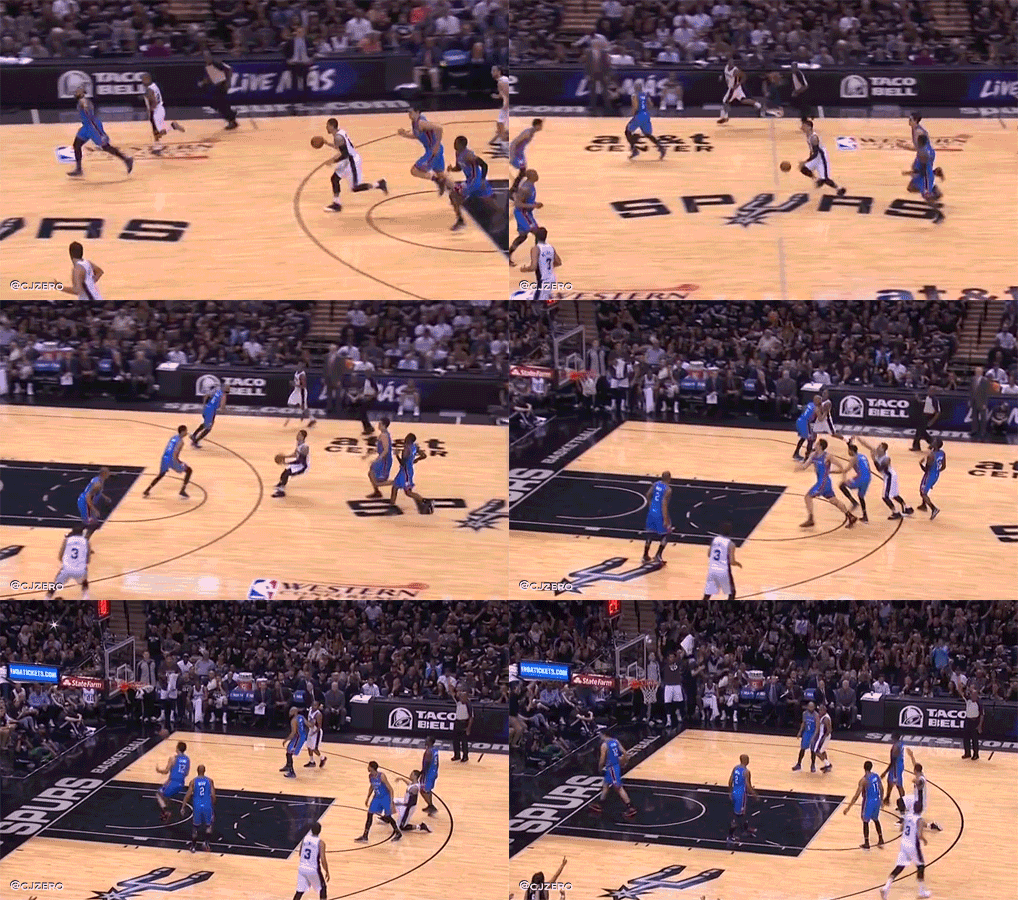
Green hit one three in the first quarter pulling up out of a fast break. It would set the dominant tone the Spurs would have all night, and was followed, in the second quarter, by two more.
Crucial to the continuous pressure San Antonio put upon the Oklahoma city was their defense of the Thunder's Russell Westbrook and Kevin Durant, who were held to a meager combined total of 30 points. Westbrook was 7-24 shooting for 15 points, while Durant went 6-16, and 0-4 from the 3 point line.
Their struggles, however, may have come less from their inability to do the work of scoring themselves, than the complete lack of scoring by anyone else on the team. This was no more evident than in the second and third quarters, in which Durant and Westbrook scored every single one the team's baskets from 8:04 in the second, to 4:29 in the third: that is, for over 12 straight minutes. This ensured Oklahoma City would fail to mount anything similar to the comeback they had in the last game in this period of time.
The only other figure to score in double figures for the Thunder was Jeremy Lamb, who (except for a minute-long contribution in the first quarter) was brought in along with many of the other Thunder bench players for most of the fourth quarter to finish out the game. He scored 13 points, going 6-8 from the field, and came up with two steals.
The Thunder will now travel back to Oklahoma City for Games 3 and 4 of the series, though going down 0-2 makes their situation much more dire. At the same time, they face a Spurs team that is looking like one of the most cooperative teams in NBA history. Looking ahead to Game 3, Durant pointed out the very different situation his own team now faced, which would seem to require something of their opponent's unbreakable integrity. "With a big loss, like that, and two games in a row, it's hard to stay positive. It's hard to stay together," Durant said.

Showing posts with label Thunder. Show all posts
Showing posts with label Thunder. Show all posts
Thursday, May 22, 2014

Wednesday, May 21, 2014
Let's get physical: Thunder vs Spurs Game 1 Recap, Game 2 Preview
 |
| Oklahoma City, meet Kawhi Leonard, aka DEATH |
First, was it the general effectivity of the Spurs offense (ball movement, spacing) or the individual matchups (Kawhi and Baynes, say) that produced this result? What led to the Spurs’ domination in the paint in the beginning of the game besides the lack of an Ibaka on the court? What was OKC actually trying to do this game—what was their game plan? Why were there so many OKC lineups that we saw? Were the Spurs more destructive in the first or the second quarter? What caused that run by OKC in the third quarter? How did Pop stop the bleeding (not Collison’s, but the Spurs’). Why couldn’t OKC make a run in the fourth? Were the Thunder really as rattled as they looked? Were the Spurs as in control as they looked?
In particular what was bothering me was whatever the hell the Thunder were doing for just about the entire first quarter. They looked completely out of sorts. The score (which was Spurs 30, OKC 27 at the end of the quarter) gave no indication as to just how wild OKC seemed, and how consistent and efficient the Spurs looked. This continued into the second quarter, really, even as they stayed close: when Derek Fisher is keeping you in the game with his strange random threes, you’re in trouble. Watching every possession for OKC gave me a queasy feeling: it was like watching water torture. You were just waiting for something to break—and when it didn’t, you weren’t relieved so much as amazed that the inevitable was held back a little. …Not that I’ve ever seen any water torture before. Just… well… you get what I mean.
A look back revealed this:
That’s Kevin Durant getting a high screen to space the top of the key and get Leonard off of him. Two people are deep in the corners—Collison and Sefalosha—and Westbrook is at the wing there to mess up the coverage by forcing Parker to either commit to help or to cover him and give up the pass to the corner. What Durant does next is dribble the ball with his patented trans-continental crossover, fakes to get the recovering Leonard into the air and neutralize his threat to the upcoming pass, and dishes the ball to Collison for the three.
What happened next has to be symbolic in some way, though I’m not quite sure how yet. Collison takes forever to get his shot off, Splitter dashes to the corner and gets a hand near him, and Collison misses by five miles, hitting the side of the backboard. The ball floats down gently after chilling in the sofa-like backboard pads for a moment and lands in Danny Green’s hands and the Spurs return to offense. (That’s what it felt like: the Spurs didn’t “go back on” offense, they simply “returned” to it, as if it was something that the distraction of OKC’s offense just kept them from doing for a couple seconds.)
They did this on about four or five possessions in the first quarter until Westbrook got impatient with it not working and began calling plays pick-and-roll with himself involved—a good strategy too but one that would have worked better had the previous one succeeded. The aim seems to have been to spread the floor and open the paint, as well as to hold onto the ball—that is, not give the Spurs any chance to pick off passes or bother any excess dribbling.
Unfortunately that is still exactly what happened. It was more pronounced in the second half, when they made more baseline cuts and Leonard swatted a few balls away and then ran the fast break. But this was already happening in the first quarter too:
Essentially the Spurs countered everything about this strategy by challenging passes well and forcing people like Collison and Butler and Fisher to freeze when they got the ball and just put up long shots.
--
Now, to everyone who said, after seeing all this, that the Thunder are done without Ibaka, and that Brooks doesn’t know what to do now—I include myself in that overzealous category—that’s not a horrible strategy to come out with, given the setback. It gives up offensive rebounds entirely (which they weren’t going to get without Ibaka anyway) and lets everyone get back on defense. The alternative—having Durant or Westbrook go to the basket, or depend on baseline cuts, as OKC is wont to do—would lead to Tony Parker absolutely destroying them possession after possession on the fast break (it also probably would have forced OKC to start Adams instead of Perkins, which they have been reluctant to do for some reason).
Granted, it’s a little odd, given that the Spurs are one of the best teams at three-point defense, and have a defensive scheme and policy that very effectively deals with the corner-three. But the Spurs are good at everything defensively and the point is just to try and get something going against them, not find any hole in their schemes—since they don’t exist. If they can get something, anything like what happens here, involving some ball movement, they may have a chance to keep the floor spread:
In short, it was not a horrible thing to start with, and shows we slightly underestimate Scott Brooks here. As Matt Moore recently pointed out, he’s a great on-the-ground strategist, rather than a big-game planner or a micromanaging play-drawer. He works well on the middle scale of things. This is exactly the sort of thing we should have expected him to do, and it wasn’t horrible. It just wasn’t effective.
And it was entirely typical of Brooks to do what he then did, and which was equally ineffective: instead of abandoning the strategy he changed lineups. This initially seemed to be because of defense, but the lineup that came out seemed to favor a smaller offensive threat as well. Which brings us to the question of small-ball. What’s easy to forget about this is that it doesn’t actually get around the Ibaka-problem at all, really, so much as plunge one directly into it. Everyone seems to be talking as if going small will help the Thunder since they can’t get anything with Ibaka going. But in truth Ibaka was essential to their small ball at the center. In many ways, they have to find some other way of running this offense as well.
Out of the first timeout Westbrook simply ran a pick and roll with KD, and this might be their best strategy, in the end: that’s an entirely unguardable pick-and-roll in itself, and if the Spurs are anywhere near late on the help in the middle, it’s two quick points for Westbrook. Of course, again, they are amazing at that particular help: people have been pointing to just how many points the Spurs made in the paint (over 60), but what’s also remarkable is just how few they gave away to the Thunder.
--
This brings us to the other amazing thing I saw last night: the Spurs defense. It wasn’t as crushing as it has been in other games, but it came through big more than enough to shut down the Thunder when it counted. Everyone talks about how great and efficient the Spurs are on offense, but on defense is where they really shine. If you do not execute perfectly, they make you pay. Any slip-up and you’ll find yourself watching them kiss the ball gently off the backboard at the other end of the court from the turnover they just forced from you. Everyone talks about how they pass the ball—what is almost more impressive is how they force you to pass the ball where they want it to be passed, and where it will be easily taken away from you.
Above all, what was interesting was the physicality. This is an OKC team that prides itself on its physical presence on the court, and yet continually San Antonio was playing with a defensive intensity that they actually ended up winning that battle. Watching them, what I realized is that there are simply more kinds of "physicality" than we like to admit. While the Spurs may not be physical in the sense of being aggressive, they simply know how to endure and keep up the pressure. Diaw gets hit in the eye by Adams. He goes and sees the doctor, then just gets back on the court and plays big minutes. Then later he goes to the hoop and gets hit on the back of the head by Westbrook. He gets up and takes the free throws. Then Kawhi gets up in Durant’s grill and takes an elbow from him right to the temple. This doesn’t faze him. He literally doesn't step back but in fact gets closer on defense. This is not agressiveness, but it is physical nonetheless. While they don’t dominate, they slowly constrict around you with their physical pressure and squeeze the life out of you, like one of Danny Green’s snakes:
The answer to the question of why exactly the Thunder were able to make a third quarter run lies somewhere around here, however. The only time the Spurs distinctly let up this brand of physicality was in the third quarter. The lack of anything that would physically stop Westbrook or anyone who came into the paint was thoroughly apparent. While the Spurs continued to cover the three point line well, they simply just let too many drives to the basket through. For their part, OKC started playing good in the middle here, using a bigger lineup, and they started making stops. Most importantly, Westbrook played brilliantly. As soon as he got the ball, he would look downcourt to find Tony Parker there. And as soon as he spotted him, you could nearly see Parker turn into a big juicy T-bone steak before his eyes. Over and over again neither Diaw nor Baynes could get quite the angle they needed to help, and so Parker was left alone facing Westbrook on several possessions when what Westbrook needed to be facing was the usual wall of San Antonio arms that they put in his face. Credit Westbrook for this—who is a genius at getting to the basket: he got a good enough angle consistently to just pressure the defense enough that they couldn’t get enough of a physical presence in front of him in transition. But what it also did is restore the effectiveness of KD, who needs a physical team to create enough space and fatigue for him to have room to shoot. KD is a physical player indirectly speaking: he himself may not totally play the most physical style of ball, but surrounding him there will sprout up a huge network of bruisers that make him absolutely deadly. Take that away, and it becomes harder for him to do his thing.
Appropriately, as soon as the Spurs came back physically--through a combination of making more shots and taking more time with the ball, bullying and tiring out OKC on offense through tough pick and rolls using Baynes, and basically slowing the game down so that the fast break became more high-risk to push—OKC was shut down. By the fourth quarter, we were seeing a half-court game again and actually a quite imposing physical presence on the court from San Antonio.
--
So what can we expect from the Game tonight? It's hard to say. Judging from everything here we've seen in the last game, more crazy lineups from Brooks, more physicality to counter the physical nature of the Spurs--expect much more Collison bleeding, but also expect more of that big lineup--and also more of that KD-Russ pick and roll, I think, whenever the going gets tough. Expect too, I think, more shots from Westbrook. He is willing this team into competition with a better opponent, and I don't see any reason for him to stop pushing the intensity and become suddenly more of a distributor. And expect more Adams, because Perkins had a horrible game, got too many fouls, looked winded and out of shape, and couldn't do anything more than his role required to try and help compensate for Ibaka. And from the Spurs, well, I think you will see more of Baynes and Manu doing this:
Once the Spurs began running these pick and rolls, control shifted back into the hands of the Spurs: Manu got involved, the load could shift off of Parker, and everything began to flow. Also, strategically, it just means death for OKC: the Baynes-Ginobili pick and roll is a particularly beautiful pick and roll to watch because there are just so many options that come out of it. Because OKC lacks Ibaka, Ginobili can let his passing genius take over, and effectively turn Baynes from someone making a mere roll into a crafty cutter, as in the above. Or he can do his Manu stuff and take the ball to the hoop himself with Baynes taking Adams out of the middle and using his body to slow up any help:
Baynes’ screens in general are a thing of beauty: he always makes a cut in some other direction to get the defender off of him even before he runs to set the screen.
Another thing I think we might see is even more of this:
There's no incentive for San Antonio to push the ball, but I feel like Green is due for an even bigger game and the OKC defense is going to try and stop bleeding points in the paint like they did last game--at least early on. This means many threes will be open, and the clip above shows just how quick he can get them up. The man's balance is an amazing thing--however much OKC will pressure him, he will be able to get a good shot off.
Above all, I think we'll see an even more physical game from San Antonio. People will be diving for balls, sticking arms out, and especially making sure the paint is absolutely covered. Any time there is small ball from OKC, they will--as they did in the last game--simply go at Reggie Jackson on the block and destroy him (Diaw and Kawhi both ended up being posted up by him and absolutely taking away anything he could do to counter). Look at that gif at the beginning of this article: that's the kind of hustle, concentration, focus you're going to be seeing much more of tonight.
Tuesday, May 20, 2014
Morning Roundup, May 20, 2014: Shameful extroversion, DiaOWW, terrifying complex organisms, Hibbert a PR genius?
 |
| Danny Green's shameful display of extroversion courtesy of Hardwood Paroxysm |
Trevor Zickgraf at 48MinutesofHell has a wonderful collection of the twitter comments as the game unfolded last night. There were several discursive regularities the debate in the public sphere raged on, and out of this the collective will of the citizenry expressed itself in a few consensus-built proposals. They were: That Serge Ibaka's absence from this series will make it a sweep. That Danny Green's ta-da pose (see above, and also the shot, which deserved such a reaction) signals the immanent corruption of Spurs internal culture, and leads one to speculate their atrocious lack of discipline, if it continues, may threaten to doom the franchise. That Boris DiaOWWW's eyeball is made of adamantine, since it was apparently strong enough to withstand Steven Adams trying to gouge it out with his massive steamshovel fingers. That Aron Baynes is the best person on the planet. That small ball doesn't work for OKC. That Charles Barkley doesn't know what the hell he is talking about, as usual. That Tim Duncan in the postgame continues to make fashion statements that would make Russell Westbrook blush.


J.A. Adande has the leader of the day (well, sorta yesterday, but I'm counting it as today) at ESPN.com: "We've been suckered by the San Antonio Spurs. We spend so much time hammering on the "Team, team, team" concept that they preach that we forget they can present some hellacious individual matchups." His great article explains how this 2013-14 Spurs team is far from being the team-centered sort of "machine" we all talk about--something I myself have been harping on continually this year to friends until I was blue in the face (thank you, Grant, for getting me to the emergency room all those times). The truth is it is full of players who are so good at what they do, in so many ways, that they produce huge matchup problems. The team concept produces the roles for the individuals, and the individuals that fit the roles become something better than the team concept. Ken Berger's great, thorough article in April got at just how productive this "adaptability" of the Spurs is for the development of individual talent. You heard it here first, folks: the right metaphor for the Spurs system is not a "machine," but something more along the lines of a complex organism. It's less like a machine than one of those transcendent freaking self-aware blobs that will eventually become our overlords. Specifically, in one aspect: individual elements produce fields of action within which the individual effort becomes more effective than if it were working by itself. Then, in turn, its collective contribution then becomes through feedback more than the individual actually could produce. The upshot? Be afraid. Be very afraid.
Harvey Araton in the New York Times has a nice good article on how Hibbert is "stabilizing" the Pacers, not unlike what Tom Ziller said yesterday. Except this dwells on his "sensitivity." There are some good quotes: "He wants to be a guy we depend on," David West tells Araton. This is significant, coming from West--who really is the guy the Pacers actually depend on. That "wants" contains a lot of ambiguity. It's interesting to speculate on whether West thinks Hibbert has actually become that guy yet in a positive sense. Because in a negative sense, it's certainly come true: essentially, the Pacers now do depend on Hibbert, in the sense that if he doesn't show up, they don't win games. Maybe threatening the team in this way, was ultimately Hibbert's only way of really sort of attaining something of that role. Obviously this wouldn't be conscious--it's just the fact that sometimes human behavior takes a pattern whereby it gets a result along lines that in retrospect look like they achieve their goals less directly than indirectly. Of course, that hurts his career in the future, but for now, it definitely secures for him what he wants. This, however, contributes to a stranger impression you get after reading the piece and thinking about the whole arc of the Hibbert story, and comparing the attention Hibbert is now getting to the relative lack of attention that Paul George--by far their most essential player--receives. At the beginning of this whole situation, some writers noticed that it was Hibbert who was becoming the scapegoat of the team, and speculated this was because of something unfair. But maybe it was sought out (mostly unconsciously, of course). Because in the end, by doing so he also risked something that George didn't risk: namely, the glory of ending up being the "savior" of the team. George puts up 20-30 a night semi-consistently now and we don't say a word: he is averaging the highest field goal percentage and (in so many games this has been crucial) the highest three-point percentage of his career in the playoffs (44% and 42%, per Basketbal-reference.com); in the Washington series he put up 18, 11, 23, 39, 15, and 12 points, and in the first game against the Heat he had 24, together with 4 rebounds and 7 assists; he has been positive in the plus-minus category in 10 out of the 14 playoff games played already--not too bad given how cruddy things have been. Hibbert puts up 10 and we freak out. It's the wrong sort of risk to take, morally speaking, but it was a risk nonetheless that George didn't dabble with. And now Hibbert seems to be reaping the rewards from it, becoming the "erratic" team's stabilizer.
Monday, May 19, 2014
Spurs Crush Thunder 122-105
I'll have an analysis and look back at the game after watching it again tomorrow morning, but for now I'll just let this serve as a recap of how it all went:

Subscribe to:
Posts (Atom)