
 |
| Danny Green's shameful display of extroversion courtesy of Hardwood Paroxysm |
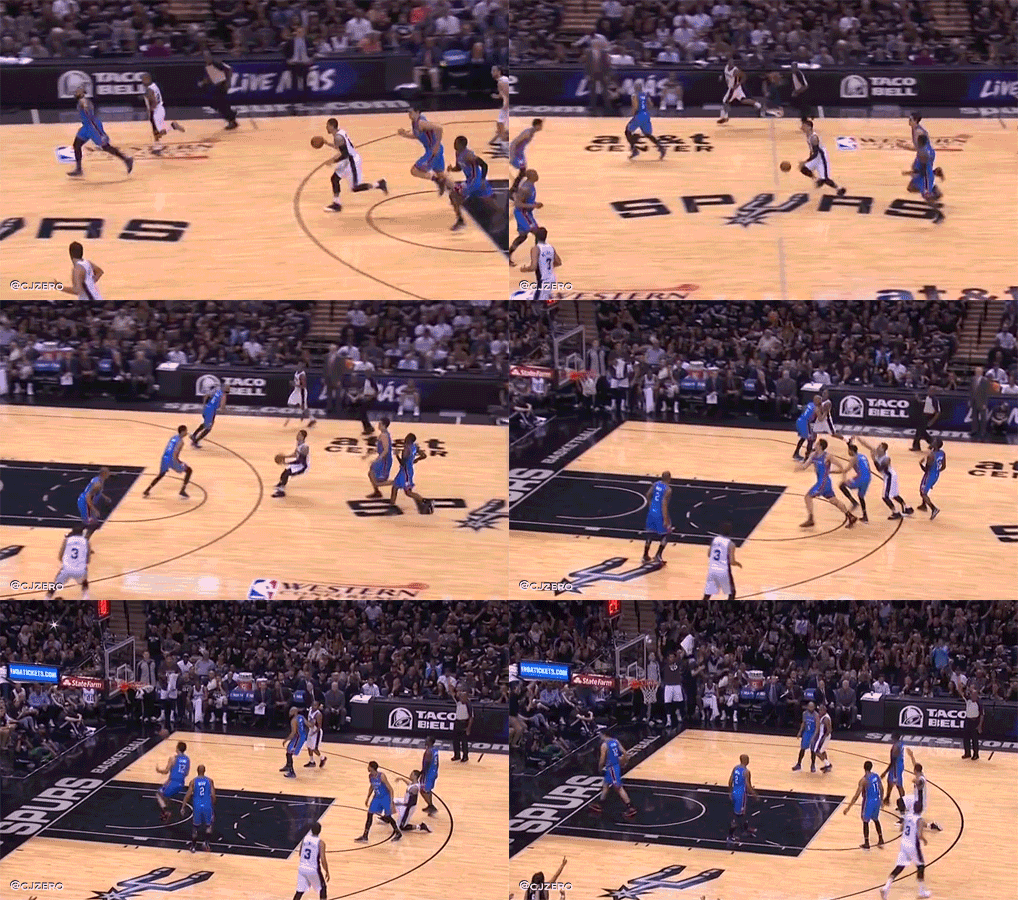
Trevor Zickgraf at 48MinutesofHell has a wonderful collection of the twitter comments as the game unfolded last night. There were several discursive regularities the debate in the public sphere raged on, and out of this the collective will of the citizenry expressed itself in a few consensus-built proposals. They were: That Serge Ibaka's absence from this series will make it a sweep. That Danny Green's ta-da pose (see above, and also the shot, which deserved such a reaction) signals the immanent corruption of Spurs internal culture, and leads one to speculate their atrocious lack of discipline, if it continues, may threaten to doom the franchise. That Boris DiaOWWW's eyeball is made of adamantine, since it was apparently strong enough to withstand Steven Adams trying to gouge it out with his massive steamshovel fingers. That Aron Baynes is the best person on the planet. That small ball doesn't work for OKC. That Charles Barkley doesn't know what the hell he is talking about, as usual. That Tim Duncan in the postgame continues to make fashion statements that would make Russell Westbrook blush.
J.A. Adande has the leader of the day (well, sorta yesterday, but I'm counting it as today) at ESPN.com: "We've been suckered by the San Antonio Spurs. We spend so much time hammering on the "Team, team, team" concept that they preach that we forget they can present some hellacious individual matchups." His great article explains how this 2013-14 Spurs team is far from being the team-centered sort of "machine" we all talk about--something I myself have been harping on continually this year to friends until I was blue in the face (thank you, Grant, for getting me to the emergency room all those times). The truth is it is full of players who are so good at what they do, in so many ways, that they produce huge matchup problems. The team concept produces the roles for the individuals, and the individuals that fit the roles become something better than the team concept. Ken Berger's great, thorough article in April got at just how productive this "adaptability" of the Spurs is for the development of individual talent. You heard it here first, folks: the right metaphor for the Spurs system is not a "machine," but something more along the lines of a complex organism. It's less like a machine than one of those transcendent freaking self-aware blobs that will eventually become our overlords. Specifically, in one aspect: individual elements produce fields of action within which the individual effort becomes more effective than if it were working by itself. Then, in turn, its collective contribution then becomes through feedback more than the individual actually could produce. The upshot? Be afraid. Be very afraid.
Harvey Araton in the New York Times has a nice good article on how Hibbert is "stabilizing" the Pacers, not unlike what Tom Ziller said yesterday. Except this dwells on his "sensitivity." There are some good quotes: "He wants to be a guy we depend on," David West tells Araton. This is significant, coming from West--who really is the guy the Pacers actually depend on. That "wants" contains a lot of ambiguity. It's interesting to speculate on whether West thinks Hibbert has actually become that guy yet in a positive sense. Because in a negative sense, it's certainly come true: essentially, the Pacers now do depend on Hibbert, in the sense that if he doesn't show up, they don't win games. Maybe threatening the team in this way, was ultimately Hibbert's only way of really sort of attaining something of that role. Obviously this wouldn't be conscious--it's just the fact that sometimes human behavior takes a pattern whereby it gets a result along lines that in retrospect look like they achieve their goals less directly than indirectly. Of course, that hurts his career in the future, but for now, it definitely secures for him what he wants. This, however, contributes to a stranger impression you get after reading the piece and thinking about the whole arc of the Hibbert story, and comparing the attention Hibbert is now getting to the relative lack of attention that Paul George--by far their most essential player--receives. At the beginning of this whole situation, some writers noticed that it was Hibbert who was becoming the scapegoat of the team, and speculated this was because of something unfair. But maybe it was sought out (mostly unconsciously, of course). Because in the end, by doing so he also risked something that George didn't risk: namely, the glory of ending up being the "savior" of the team. George puts up 20-30 a night semi-consistently now and we don't say a word: he is averaging the highest field goal percentage and (in so many games this has been crucial) the highest three-point percentage of his career in the playoffs (44% and 42%, per Basketbal-reference.com); in the Washington series he put up 18, 11, 23, 39, 15, and 12 points, and in the first game against the Heat he had 24, together with 4 rebounds and 7 assists; he has been positive in the plus-minus category in 10 out of the 14 playoff games played already--not too bad given how cruddy things have been. Hibbert puts up 10 and we freak out. It's the wrong sort of risk to take, morally speaking, but it was a risk nonetheless that George didn't dabble with. And now Hibbert seems to be reaping the rewards from it, becoming the "erratic" team's stabilizer.



No comments:
Post a Comment