Showing posts with label Heat. Show all posts

Sunday, June 15, 2014

Game 4 recap: What the Spurs and Heat leave us with


Tony Parker drives inside and underneath, then slips the ball out to Patty Mills, who has drifted down to the corner.  Mills is open, his hands ready.  Parker, under the basket and carried out of bounds, sidles up near the hoopstand then skips a little to his left, out away towards the wing he came from and far away from Parker, already leaking back towards the fast break and opening up the lane.

In the lane is where Tim Duncan has been for the majority of this possession.  After slipping a screen for Ginobili, who passed the ball to Mills, who swung it to Parker, who made his drive—after this screen Duncan fell towards the baseline, moving between the left elbow and the left block and opening up his body to show for the ball, and then parked himself comfortably on the left block.  But as soon as the ball crossed over to Mills in the corner, Duncan turns his body in the opposite direction, pivoting around and moving backwards square into the body of Bosh, who has gone over to block Parker’s shot.  It’s like Bosh had a target on him.  He’s the only player over 6’8 on the floor, and Duncan hits him right in the chest with his back, pins his left arm behind him, and backs him out of the paint.

Space also opens up in the lane because Manu Ginobili, on the other side, has darted in front of Dwayne Wade, after shoveling the ball to Mills, who swung it to Parker.  As soon as Parker leaves his feet to sling the ball  back over to Mills, he slides in front of Wade and puts a body between him and the basket at the left block.

There’s been much talk of how the Heat were lazy on this play, watched the ball, didn’t box out.  But Kawhi Leonard, who speeds down through the open lane, grabs the rebound for the most spectacular putback dunk of the playoffs and perhaps the whole season, also found his way there because every single Spur was doing what he needed to do, to a T, to make it happen.

If the Spurs win the Finals tonight, as they seem poised to do, it is because of this sort of sheer determination by every single one of the players to get the small things exactly right, all of the time.  After every game, this has been their refrain: we got to keep doing all the small things right.  While Erik Spoelstra talks excellently and eloquently to his team about focusing, about grinding, about executing, everything we hear from Popovich—and while we do not hear much, really, but the difference in what we do hear is telling—is about boxing out, about getting a loose ball, about running towards the chest of the defender, about getting the next rebound, about putting in five minutes of effort.  We talk about the Spurs as a machine, but the Heat use a vocabulary to describe themselves that is more process-based, that emphasizes abstract and vague mechanical workings.  The Spurs talk about concrete, definite, extremely small and extremely precise objectives, and attaining them every single possession.

Playing on this level, in an almost uncanny state of communion with the exact requirements of the moment, the instant, is indeed the only way they could put on the spectacular display they do.  So much work goes into every single use of the ball, so much effort risks being wasted through extra cuts, extra screens, extra passes which don’t go anywhere, that we begin to think that the question the Spurs ask themselves continually is not, “what extra work do I need to do to make the right move here,” but, “why would anyone ever do anything less than the right move?”


And that is the question they leave us with, ultimately: why would we ever want to do anything less than what is exactly demanded by the moment?  Why would we respond with anything less than full effort?  The answer is supplied by the Heat, who now have left themselves in the position of having to make history to come back from their 3-1 deficit—something no one has done: namely, to risk saving up that extra something for efforts that are more than what is required, that are exceptional and great and frankly unbelievable.  To not just respond, but to make a statement.  This, however, risks dismissing the fact that responses to what the situation demands are statements also, and that to be able to put in effort in the here and now, may be really also the only way to achieve as much as the Spurs have in the long term, to achieve something historic.

Saturday, June 14, 2014

Game 4 recap: on the Heat's "extra gear"

Erik Spoelstra said after the fourth game of the NBA Finals on Thursday that he would be “checking under the hood” of this Heat team, to try and see what could be fixed.

Maybe he’ll find that something in the gearbox was missing.

We all hear about the Heat’s “other gear.”  The metaphor is used loosely, but it’s meaning is clear.  The Heat possess something that steps up their game when the time calls for it.  That raises their top speed, that allows them to move faster.  The other gear is what allows the team to coast along the smooth wide roads of the regular season, and then, when they hit the highway of the playoffs, to speed up, shift, and blow by the other traffic. 

In the 107-86 Spurs victory, there was no evidence of any other gear there.  The team seemed merely to be clanking along.

Something of the same thing happened in Game 3, as San Antonio blew out the Heat 111-92.  But because the Spurs played so exceptionally well, and because the Heat were able to mount something of a comeback—nothing like an “extra gear” performance by any means, just a solid, determined effort to grind away at the lead and reduce it—it wasn’t clear whether the Heat’s inability to challenge them was a fluke thing or not.

But after an hour and twenty minutes of looking at film of the Spurs’ miraculous performance, and their own failure to keep up, we would expect the Heat to have come out in Game 4 at least with some better sense of what to do to make the Spurs work for what came to them so easily in that third game.
Instead, they played almost the exact same way: sloppy on defense, tired on offense, not finding open players, making bad decisions.  “I was surprised,” Spoelstra said.

He may well be surprised because what he thought was always there, and what was always there for the Heat, didn’t seem to show up.  It’s a real possibility the “extra gear” the Heat rely upon so thoroughly, and which is supposed to bring higher levels of performance out of them, isn’t there.

Indeed, it becomes dubious as to whether the intense effort that they used to step up their game ever constituted anything like an extra gear in the first place.  The better metaphor might have been something like putting nitrous oxide in the fuel supply.  The Heat’s inner workings may well not be designed around the presence of some special and separate level of performance so much as simply given a boost from outside additives that increase the pressure and make things run faster.

The Heat play an extremely difficult brand of defense (as Grantland's netw3rk pointed out well), as well as an extremely tasking brand of offense.  The fuel needed to speed it up, to make it work better, doesn’t come from it’s inner workings, the way it is schemed, the way it is run.  The Heat’s defense, when it is playing better, simply goes harder: the “blitz” that they use on the pick and roll play, for example, can work efficiently enough through its mere aggressiveness as a ploy.  It becomes better, it goes to another level when it is done with extra focus and added intensity—not when anything crucial or strategic about it is changed.  Offensively, their isolation plays create through constant, focused improvisation, and only becomes better by simply working more intensely: when LeBron, that is, or Wade, begin to simply play harder.

In a way, understanding how they work this way, makes their achievements more impressive.  They almost reached through their effort a level of efficiency that made us suspect the whole vehicle was set up differently than we thought it was, internally, on the inside.  They played so hard that whole vehicle in general almost turned into a differently configured machine than the one we saw during the season.

It makes their achievement last season in particular quite amazing, really: the suggestions floating around which LeBron James is worried about—that the Heat didn’t really win it, but got lucky—are all the more baseless (and not just because luck is part of the game and doesn’t invalidate anything in it when it falls one way or the other).  They played with such effort that things which happened because of the intense pressure they put upon themselves looked like opportunities only the most fortunate could have for themselves.

Even more than that, though, understanding them this way doesn’t give credence to the notion that because the Heat are simply worn out, they don’t “really” want the championship in the same way they did before—because if they did, they would switch it into that extra gear, presumably.  This is something that has been insinuated in all this talk of the “gear” in general, and put in franker and different terms by Mark Jackson and Jeff Van Gundy during the Game 4 broadcast, and their hounding of the Heat to “want it more.”  The Heat may indeed be bringing the extra intensity that won the championship last year.  It is just that, because this doesn’t make them into a different machine, but the same one only moreso, it can be beat by greater intensity.

Against a team that knows the workings of their machine inside and out like the Spurs, that has reverse engineered them over and over again, and that can pick them apart with a tinkerer’s precision, it becomes clear that the difference involved in the “extra gear” is simply one of intensity, not of kind—of quantity, not quality.  Because if the Spurs play with extra levels of intensity and effort—as they indeed are in this series—they can completely counteract everything the Heat can throw at them.   It just involves picking them apart more swiftly, thoroughly, ruthlessly.  And that is exactly what they did to them in Game 4.

So why did we think that the Heat’s “extra gear” existed in the first place?  Perhaps because the inner motivation that makes a player simply, frankly, merely play harder is quite opaque to us.  “Wanting it more” is a strange and almost empty notion: if we have a desire, it motivates us.  It’s that simple.  To want the thing more, doesn’t really alter the nature of the desire—unless this makes it another desire.  Also, to want something means wanting it practically, wanting it in a way that can translate into action—not disappearing into the realm of magical thinking where we think it can be gotten just merely because of the intensity of our want.  And if everything you are doing is indeed translating into action and effort, it is hard to see where further effort can be put in.

With all that being the case, it may just be easier to think that the Heat aren’t trying at the limit of their efforts, but actually just fiddling with the gearstick when they want, and becoming whatever they want to be.  What’s clear is that if any of the Heat themselves share this conception of their efforts, the Spurs surely are disabusing them of it pretty thoroughly.  Through this championship series, in other words, the Heat may finally learn how to appreciate their history of intensity and effort a little more than they already do.  It would be however sad to have to learn it through such thorough, crushing defeat.

Wednesday, June 11, 2014

Spurs reach basketball equivalent of nirvana: NBA Finals Game 3 Recap and Analysis


The Spurs last night were on some other, more ethereal plane of basketball existence.  It can’t be described any other way.

During the game—during merely the first quarter—people in the twitterverse were joking that we reached peak Spurs. But in a way we reached peak basketball, as they think it may be best played.

The stuff they did in that first half was unbelievable, and may have been just the most efficient, well executed basketball we will ever see.  Popovich after the game put it frankly: he never expects to see anything like that again, ever.  That’s how good it was.


And it’s not a coincidence that Tim Duncan, after the game, when asked about their historic first half efficiency, said that at the time he didn’t know how well they were shooting.  That he didn’t care.  Because we also saw last night a form of focus and concentration by the team that really was like it was on a different sort of level.  At times, watching the Spurs looked like a kind of struggle simply to see where this flow could take them—outscoring the other team was a kind of an afterthought.

--

The most visible form of this, was simply in the fact that they showed no signs of fear at all.  There are teams that don’t care too much about the Heat—the Bulls, the Nets.  But on some level, there’s an awareness that they pose a threat, an awareness that causes hesitation, causes lapses.  And everyone fears LeBron James.

But here’s what Danny Green thinks of the Heat:


And here’s what he thinks of LeBron James:


This fearlessness of the Spurs, this unwillingness to hesitate or to worry, was the most remarkable aspect of their effort last night. 

LeBron didn’t faze anyone, really.  Every time he closed out on Kawhi, Kawhi didn’t flinch:


And if Kawhi didn’t care about LeBron, he surely didn’t care about Lewis:


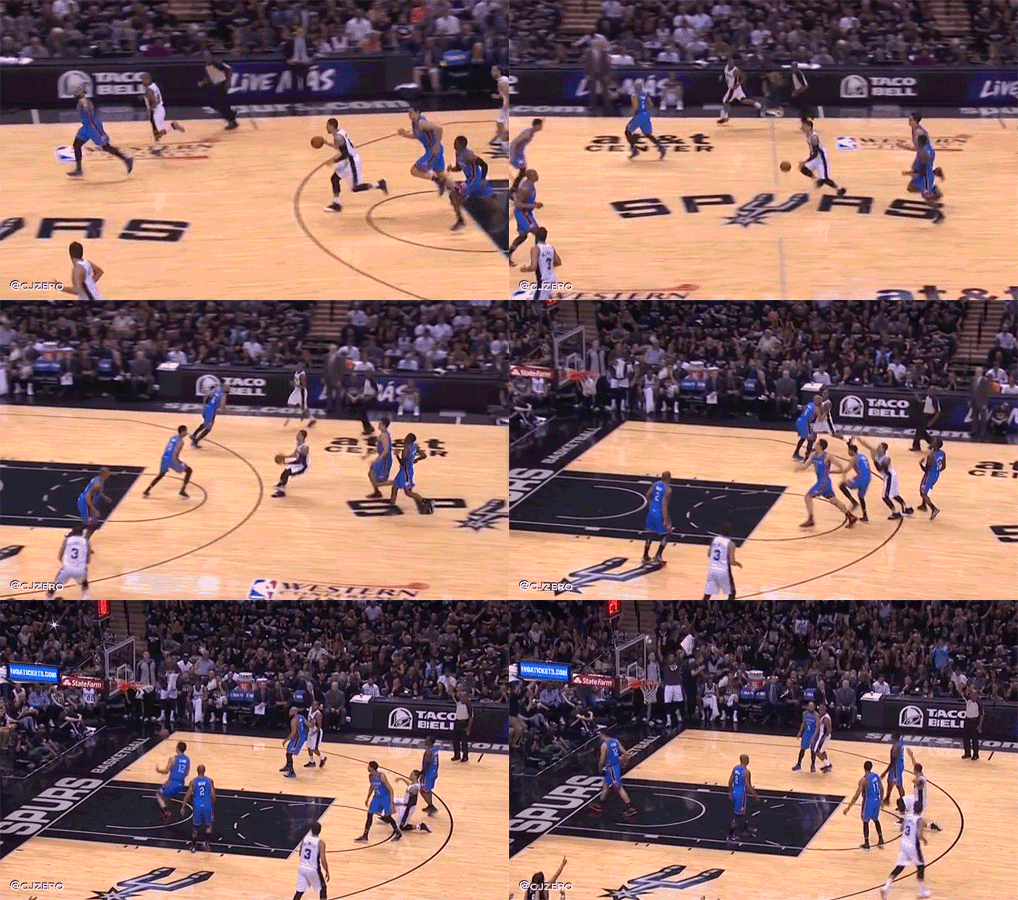
In fact, he didn’t care about anything.  This was evident on his most amazing possession of the night, which you can see at the beginning of this piece.  Leonard makes a crazy cut to the corner, Danny Green throws him the ball.  James closes out on Leonard, and Kawhi turns, spins and just goes up.  Bosh is there, closing out on him as well, and Kawhi doesn’t mind at all—he just spun LeBron.

This seems like something we haven’t seen Kawhi do in a game.  We may have seen video of him do it in practice and in college.  But this is the sort of basketball that he has only explored under duress in the game, in crazy finishes or in drawing fouls.  Here he simply turns and shoots, uses his athleticism and his balance and just drains it.

This is a fearlessness, a level of focus and flow, that was just unreal to watch.  It was as if nothing mattered on the court to Leonard, as if everything disappeared—and yet precisely by everything being factored in and accounted for and given its due weight.

--

Compare Mario Chalmers or Norris Cole’s scattershot focus this game and you get a sense of just on what level he must be working, how it involves a completely different direction of energy and effort.  Kawhi doesn’t look like he’s trying to command the situation, like Chalmers and Cole; he looks like he’s trying simply to let any excess go.  The situation on the floor isn’t too full of things to manage, to count up and count in; it is if anything too full of things to let go, remove. It is not a deep but a shallow intensity, one that lets the occasion roll off of him, so that everything needless fall away.

Kawhi also had a great quote at halftime: he said that one of the most fortunate things of the first half was that “my teammates were able to keep up with me.” And that’s really it: his performance set the tone for the rest of the Spurs.  They simply didn’t mind.  In particular, what this led to is a sort of realization: namely that at any one time, three out of five people that the Heat have on the court can’t play defense at a championship level anymore.  Rashard Lewis, Ray Allen, Chris Andersen and, yes, Dwayne Wade, simply can’t keep up.  So Boris Diaw has no problem when he finds himself backing down Lewis in the post.


The young guys aren’t that much better: Haslem might be fine, but Chalmers too isn’t effective alone, and Norris Cole can get fazed easily.  It’s only Bosh and James out there, really.  Look for the Heat to try and correct this in the next game.  But it was one thing that caused such a decimation and demoralization by the Spurs in this one.

--

As Manu Ginobili pointed out in the post-game, however, the Spurs could be almost as proud of their defense as their offense.  That’s where the concentration really showed up as a greater attention to detail.
Green has reached Patrick Beverley-levels of peskiness, something we’ve never seen him really do before.  His five steals were all taken right from the defender in the most ruthless way possible.

And then there is Kawhi’s defense of LeBron, which was just completely on point continually.


And together the team simply did this if he drove to the hoop:


This absolute command of the floorspace produced all sorts of mistakes on the part of the Heat.  You can’t win a Finals series if you do this:


That’s Danny Green successfully guarding Chris Bosh in the post, forcing an entry pass way too far baseline, which Bosh can’t catch.  What should have been a matchup nightmare for the Spurs becomes for them an opportunity to force a Heat turnover.

That’s quite simply the level of efficiency that they are working at now, and it’s nearly frightening in its sheer indifference to the will of their opponent.  Danny Green, like Kawhi, doesn’t act at all here like he cares that his opponent is bigger than him, longer than him, has more experience in the post than him.

--

People have been calling for the Spurs to be more aggressive, to take it to the paint more often, to not let the ball to swing around endlessly outside.  This was the lesson they learned, supposedly, against the Thunder: that they can be a physical team if they want to.

But it may have been Cory Joseph’s example during that game that actually gave the Spurs the key to what they needed to win a championship.  He simply didn’t care that Serge Ibaka was in front of him: he would dunk on the man anyway.  Serge Ibaka was, essentially, nothing to him.  Efficiency as a result of effort is one thing.  Efficiency as a result of indifference to obstacles, is another.  And the latter has brought the Spurs into another sphere altogether.

Tuesday, May 20, 2014

Morning Roundup, May 20, 2014: Shameful extroversion, DiaOWW, terrifying complex organisms, Hibbert a PR genius?

Danny Green's shameful display of extroversion courtesy of Hardwood Paroxysm
Well, it's morning in Hawaii still, I think.  Got around to this a little later than I wanted to.  Will be a bit smaller than usual, hopefully, because I got a lot of other content to put up here (game recap, that analysis of The Hand article I promised yesterday, plenty of gifs), but here you go:

Trevor Zickgraf at 48MinutesofHell has a wonderful collection of the twitter comments as the game unfolded last night.  There were several discursive regularities the debate in the public sphere raged on, and out of this the collective will of the citizenry expressed itself in a few consensus-built proposals.  They were: That Serge Ibaka's absence from this series will make it a sweep.  That Danny Green's ta-da pose (see above, and also the shot, which deserved such a reaction) signals the immanent corruption of Spurs internal culture, and leads one to speculate their atrocious lack of discipline, if it continues, may threaten to doom the franchise.  That Boris DiaOWWW's eyeball is made of adamantine, since it was apparently strong enough to withstand Steven Adams trying to gouge it out with his massive steamshovel fingers.  That Aron Baynes is the best person on the planet.  That small ball doesn't work for OKC. That Charles Barkley doesn't know what the hell he is talking about, as usual.  That Tim Duncan in the postgame continues to make fashion statements that would make Russell Westbrook blush.

J.A. Adande has the leader of the day (well, sorta yesterday, but I'm counting it as today) at ESPN.com: "We've been suckered by the San Antonio Spurs. We spend so much time hammering on the "Team, team, team" concept that they preach that we forget they can present some hellacious individual matchups."  His great article explains how this 2013-14 Spurs team is far from being the team-centered sort of "machine" we all talk about--something I myself have been harping on continually this year to friends until I was blue in the face (thank you, Grant, for getting me to the emergency room all those times).  The truth is it is full of players who are so good at what they do, in so many ways, that they produce huge matchup problems.  The team concept produces the roles for the individuals, and the individuals that fit the roles become something better than the team concept.  Ken Berger's great, thorough article in April got at just how productive this "adaptability" of the Spurs is for the development of individual talent.  You heard it here first, folks: the right metaphor for the Spurs system is not a "machine," but something more along the lines of a complex organism.  It's less like a machine than one of those transcendent freaking self-aware blobs that will eventually become our overlords.  Specifically, in one aspect: individual elements produce fields of action within which the individual effort becomes more effective than if it were working by itself.  Then, in turn, its collective contribution then becomes through feedback more than the individual actually could produce.  The upshot?  Be afraid.  Be very afraid.

Harvey Araton in the New York Times has a nice good article on how Hibbert is "stabilizing" the Pacers, not unlike what Tom Ziller said yesterday.  Except this dwells on his "sensitivity."  There are some good quotes: "He wants to be a guy we depend on," David West tells Araton.  This is significant, coming from West--who really is the guy the Pacers actually depend on.  That "wants" contains a lot of ambiguity.  It's interesting to speculate on whether West thinks Hibbert has actually become that guy yet in a positive sense.  Because in a negative sense, it's certainly come true: essentially, the Pacers now do depend on Hibbert, in the sense that if he doesn't show up, they don't win games.  Maybe threatening the team in this way, was ultimately Hibbert's only way of really sort of attaining something of that role.  Obviously this wouldn't be conscious--it's just the fact that sometimes human behavior takes a pattern whereby it gets a result along lines that in retrospect look like they achieve their goals less directly than indirectly.  Of course, that hurts his career in the future, but for now, it definitely secures for him what he wants.  This, however, contributes to a stranger impression you get after reading the piece and thinking about the whole arc of the Hibbert story, and comparing the attention Hibbert is now getting to the relative lack of attention that Paul George--by far their most essential player--receives.  At the beginning of this whole situation, some writers noticed that it was Hibbert who was becoming the scapegoat of the team, and speculated this was because of something unfair.  But maybe it was sought out (mostly unconsciously, of course).  Because in the end, by doing so he also risked something that George didn't risk: namely, the glory of ending up being the "savior" of the team.  George puts up 20-30 a night semi-consistently now and we don't say a word: he is averaging the highest field goal percentage and (in so many games this has been crucial) the highest three-point percentage of his career in the playoffs (44% and 42%, per Basketbal-reference.com); in the Washington series he put up 18, 11, 23, 39, 15, and 12 points, and in the first game against the Heat he had 24, together with 4 rebounds and 7 assists; he has been positive in the plus-minus category in 10 out of the 14 playoff games played already--not too bad given how cruddy things have been.  Hibbert puts up 10 and we freak out.  It's the wrong sort of risk to take, morally speaking, but it was a risk nonetheless that George didn't dabble with.  And now Hibbert seems to be reaping the rewards from it, becoming the "erratic" team's stabilizer.

Sunday, May 18, 2014

What won't happen to the Pacers today

Basically, this:


Or this:


Or even this:


In short, Marcin Gortat won't happen to the Pacers today.  And, in other terms, post-play won't happen, unless Spo mixes things up on them and goes real big--like, puts Oden in there.  That's not happening.  Or if it does, it will be for defensive, not offensive reasons.

And this is what will make the Pacers dangerous for the Heat, then, as many have been pointing out.  The Heat are simply not a big post-up team, but that might actually be the best way to defeat the Pacers, because they're so good at clogging the paint and have Hibbert--the LeBron stopper.

The most post-up work we'll probably see is Bosh at the high post, trying to space the painted area--something I do think will be very effective.  But we won't see him rolling much to the basket in a way that cuts off the help and slices through Indiana in the same way.  Haslem will get some work, but it remains to be seen just how much.  It could go any which way. But I have a feeling they'll want to keep the ball in Chalmers' or Cole's hands (Wade has his work cut out for him this series, and may be stopped--then again he too could go off like nuts if he finds a way to beat Lance) and those of James.

LeBron too has been posting up more this year and getting more comfortable working closer to the basket, even when mismatches aren't as huge as we'd probably like for him.  But I doubt that will factor into this series as much as it did against the Nets.

More likely for him will be the situation we see last here, in which Gortat sinks a beautiful turnaround near the baseline.  Even this, however, won't happen as damagingly to the Pacers, who in this situation simply don't have the same sort of coverage they might have if LeBron is down there--not to mention the fact that the way James would end up in that spot is not through a pass into the post.  It will be the result of a failed drive to the basket, and probably happen completely off the dribble, and with a floor spaced in a way that allows greater containment and a double-team or trap.

In short, the Pacers face less of a threat in this series in certain ways than they did with the last one.  The Heat, however, are going to be coming at them at a pace they haven't seen in the regular season.

So, a hat tip to Gortat for playing arguably the best post-game of this postseason so far.  And a bit of a requiem here for post play in general.  There is, indeed, Hibbert on offense.  But I'm just not sure what to expect there, both because of his own performance issues (his jump hook looked on in the last series), and (mostly) because I have a suspicion that the Heat will contain him somehow.  We'll know a little better whether to expect.  But I have a suspicion that we'll have to wait for Timmy and Splitter do big things in their next series to see the sort of post-play highlights Gortat gave us.  With Ibaka out, there may be more than a few.

Wednesday, May 7, 2014

Brooklyn vs Miami, Game 1


I think like many people I basically took a break from watching the Heat for this first round of playoffs. There were too many other good games, with too many other good teams. And when I did tune in to watch them play the Bobcats, I was watching Al Jefferson and Kemba Walker. Even the Heat didn't seem that interested.  So it's nice to come back and see them play. It's like I was opening a favorite box of cigars and taking another out. I got another chance to savor everything I remembered liking.

Miami is looking good--and I do want to emphasize just their look alone. They still have the look of a championship team. It may be a trick of the eye, but there are times at which a certain level of efficiency, of singleness of purpose, just seems to radiate out from the movement of a team on the court, from the energy the individual players bring, from the way they interact with the crowd--all of it. After each possession you are left not just with the sense that the play was executed correctly, but also satisfactorily--as if there were some kind of higher standard to which everyone was operating and which no one needed to talk about. You can see glimpses of it in the Clippers when they are at their very best; Oklahoma City lacks it; San Antonio blinds one with it. But the Heat thoroughly look it, though it may not be as impressive as it was last year, say.

What was immediately so impressive in this game was the ability of Miami to split a defense in the interior. The passing on the inside is so smart; players are so in tune with one another. The more and more this happens the more and more I don't see Brooklyn having anything that can contend with it. In the second quarter Chris Bosh faked dribbling to the hoop and dished a pass to LeBron--cutting to the hoop at the exact right moment--with such grace and ease, you were left thinking these two must know every single tendency of the other, how they like their coffee, what drinks they enjoy, all sorts of intimate things even friends don't quite know about each other. Brooklyn looks too slow and too syrupy to contend with this: not in the sense that they are unable to defend in general, but just that they are unable to muster the type of awareness required to stop such movement and passing as this. The Heat play in the paint and pass to each other there like other teams play in the halfcourt. It's an immense space for them. And this should terrify Brooklyn.

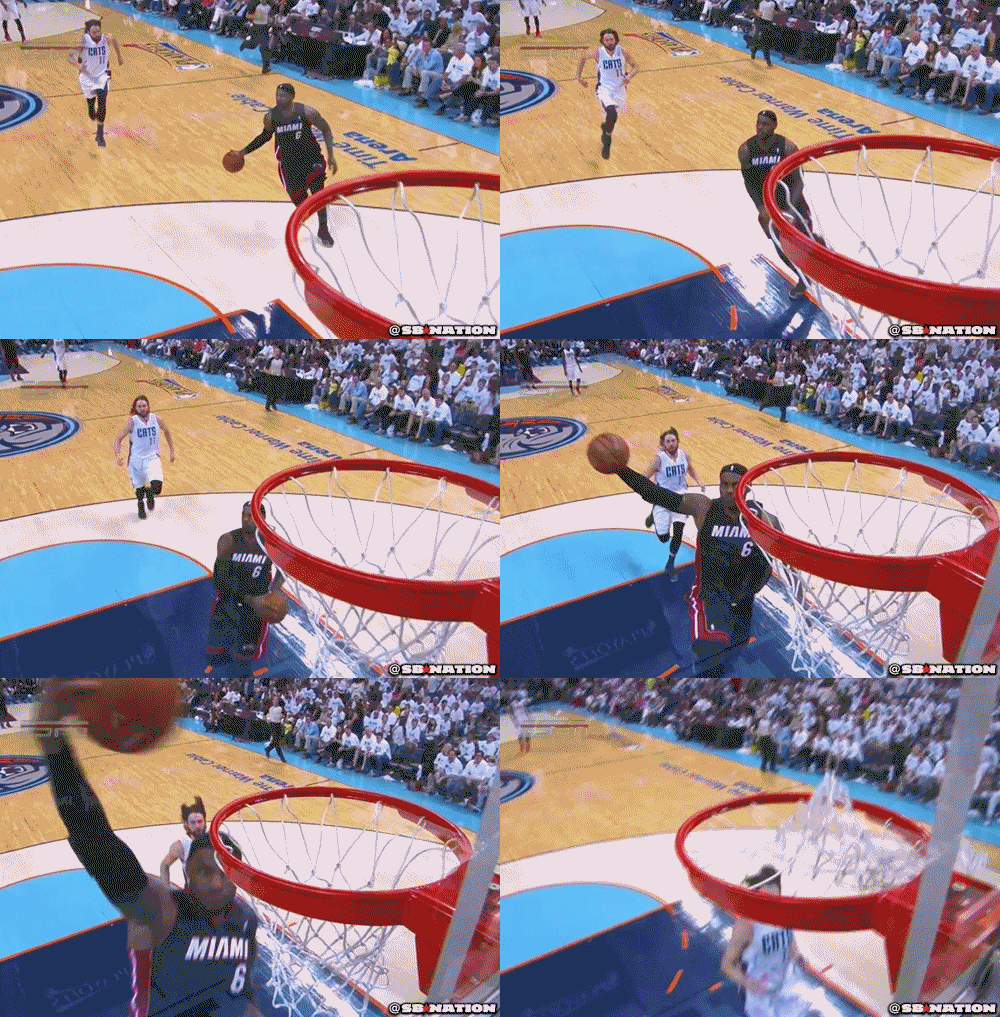
They are also still too good at fast breaks, but helpfully Brooklyn looks like they are moving the ball so wisely, so methodically, that this isn't even an issue: steals or deflections leading to thunderous LeBron-Wade fast breaks are going to only appear in this series sporadically if Brooklyn keeps up what they are currently doing. The opportunities are simply not there. I saw Brooklyn play one pick and roll in the first half. One: in today's NBA, that's just amazing. And of course the Heat simply did Heat-things with it: LeBron blitzed it, pushing out to the halfcourt and trapping, not caring about the roll-man, and this forced a weird bouncepass out and an attempt to swing the ball to the wing which simply got thrown out of bounds. (This, by the way, is how effective the Heat's blitzing of the pick-and-roll is: it messes up the opposing team's offense so wholly, that even when the pass to the open man is there the offense is so rattled they can't complete it.) Brooklyn, however, only made this mistake once, and you know that all the skill one saw unbottled in their work with that play will simply have to go to waste until they meet up with a team that doesn't move the ball so patiently.

As for that offense of Brooklyn, it seemed highly effective, if a little plodding. There was a lot of using up the clock, lots of finding Joe Johnson with about four seconds to go for threes. There are a couple looks in the paint that were just missed. Paul Pierce continues to impress as a clutch spot-up jump shooter. Deron Williams continues to look more like a shooting guard than a point guard--his two amazing shots to close the second and third quarters, only sort of reaffirm this. The bench isn't looking too good, however: they look like they can play fast in transition, but the gameplan doesn't allow for much of that. Kidd might somehow figure out a way to make that more effective in the further games, since as a unit they aren't looking like they have much offensive power otherwise.

Miami just has too many resources, however, for this to look promising for Brooklyn. Every Miami player has a special aura about them, a glow, as if each shot, each move, each play, were the fated culmination of some really involved personal backstory of triumph and hardship. Every shot by Ray Allen is like this. You know what is going to happen, and more importantly why it is going to happen. Each shot seems to be absolutely destined to go in the basket, and every shot by his teammates seems like it had to occur in precisely that way. Contrast this to how KG looks when he works, which is dead, except for five minutes or so of absolute brilliance and his amazing off-court coaching: things seem so much more uphill for Brooklyn. The only thing that resembles this atmosphere on the Heat is Wade's game, which still looks a little shaky, despite the fact he drove to the basket and made shots off the glass someone ten years younger and healthier couldn't dream of making.

The most wonderful thing about this game however is simply that LeBron is looking pumped, and is playing post a lot on Livingston, and really seems to like it. He's been looking like he is just enjoying his physical prowess more and more. Before this seemed to be dedicated to some goal--to beating KD to the MVP trophy: now he seems simply to be learning how to enjoy it to the full. It is going to be a sweet, sweet series to watch.