

The Rockets have an image problem.
This shouldn't be so. They have one of the nicest and most interesting GM's in the NBA, who also happens to have the most likable spellings of a popular first name ever (these things count for something). They also have one of the most likable histories of any NBA team: who ever had a problem with those early 90s Rockets teams? They still wear one of the best jerseys in the NBA, all mustard and ketchup (though the gray and red feels like it is phasing this out year after year). And they are in Texas. How can you really hate any NBA team from Texas? To operate any sports team that does not use a football down there is a supreme accomplishment, the nobility of whose cause should be recognized.
But their players consistently come off as cynical and their front office continually makes moves that look heartless.
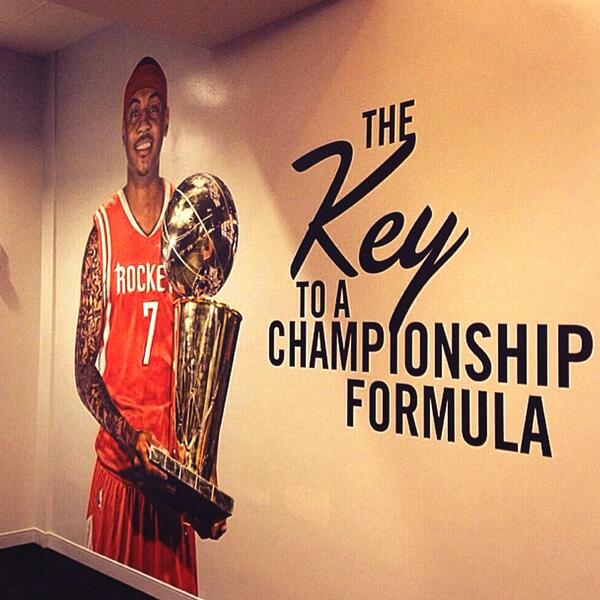
Last week that front office sent Omar Asik packing to the Pelicans, after a season of underutilizing him and sticking him on the bench when initially he promised to be a key component of their success. Today the team put up a billboard with Carmelo Anthony in a Rockets uniform, wearing the number of one of their current players--Jeremy Lin.
Lin on Twitter said he concurred with fans offended by the billboard, and that he advised turning the other cheek. Apparently news just has come out from Adrian Wojnarowski that Lin was pre-informed of the use of the number on the billboard. But that the advice to his fans had to be given, is a problem, and that Lin was informed still does not mean he approved of the move--or that the front office cared if he did or not. (Update: now Woj informs us that Lin's agents say Lin was not informed. In the end, the billboard is still there--along with other decorations--and that's the only real important thing.)
It is the culmination of a long season in which Lin was discussed more like an piece of ugly furniture than a human being, more as a source of problems for the team moving forward than as a reason for its current success. Moving Lin became an implicit element in the team's public discussions of how it would move forward, despite his significant contributions to the team's playoff-making record.
This year, Lin embraced the role of a bench player and sixth-man, coming out in flashes, wreaking havoc on defenses, and putting up very good numbers in a short amount of time. But instead of bolstering support for these achievements of the most prominent Asian-American player in the league, and giving him a sendoff that commanded the respect of fans and the league worldwide, they let him become a talking point for people concerned with the Rockets' various problems. And now, by not jumping out ahead on the PR front, they are actively contributing to the problem.
As for Asik: he came to Houston with the opportunity to play a crucial role in the team as a starting center. He worked hard, and remains one of the more offensively consistent and defensively impressive centers in the league. The dream of his becoming a fixture for the team, however, was instantly scuttled when the front office brought in Dwight Howard. Using Howard instantly became the priority, and utterly crushed any chance that Asik had of being productive. He never quite seemed to fit into the bench role, and whenever he did play with Howard at the 4 and 5 spot, no one seemed interested in making things gel for him: Dwight got all the touches, Asik just did the dirty work and picked up the pieces.
These are both understandable moves by the team, from a business and a basketball standpoint. Melo has to be courted heavily if they want him. Lin's big contract ate up the books, and in the end has to go if the team is going to go anywhere. Dwight is an amazing asset for the team--as he showed in the playoffs this year against the Blazers--and certainly a better one than Asik. Moving the latter just makes sense.
Nevertheless, the way they went about both of these things leaves a bitter taste in the mouth. They have to do a better job of handling these moves with tact and making them attractive to fans and to followers of the league. As it stands, they seem to just be concerned with the mere mechanics of each of these steps, and in the end more focused on results than with the process that leads to the results.
The burden may be on the front office itself. Morey is wonderful, but too much manipulation of the team without any concern for chemistry might indeed be the thing that produces the basketball product they bring on the court, and the product they present to the public: a cynical, results-based system that has little concern for establishing a tradition of winning and little concern for its players besides their output.
People say that the Rockets' main problem is that they lack a culture: it seems like teamwork isn't a priority, that all that matters to everyone is the bottom line.
But in a way, this is a culture, and the problem with the organization is that they actively try and promote this, rather than promoting something different.
It is fun to make the team look like it is on the cutting edge of developments in the NBA, that the team is being run as sophisticatedly as possible. But if the PR department could also do a bit more to communicate the nature of the relationship between the players, the substantial goals they are after, the sense that what is also going on is that the team has become one of the most exciting and varied melting-pots for NBA talent in the league, the impact of Morey's moves might be viewed more positively.
It is not enough for them to say they're going to send some people to Hakeem to learn post moves. That's not something that shows they have a culture. It's not enough to make a big deal about an NBA Legend coaching the team, and say nothing about how his coaching engenders a special team dynamic. It is not enough to make commentators and fans feel that they are entitled to win a series with the Blazers, for example--as they did this year--simply because on paper everything seems as if they should be good. This is, however, what they end up doing: it is the most positive feeling that they engendered in spectators this last year. And when the best value you can promote is a sense of entitlement, there is something wrong and ineffective about how you are promoting yourself.
In the end, the Rockets are truly one of the most exciting and fun teams to watch in the NBA. They play one of the most experimental brands of basketball in the league. They operate as a team with unprecedented flexibility and adaptability--a true accomplishment in this new NBA hampered by a complex salary cap. And they do so with one of the most diverse and interesting NBA rosters there are. Really, who could have predicted three such people as Jeremy Lin, Patrick Beverley, and Chandler Parsons could ever come together on a team? Lin is an ultracreative ball-handling wizard whose aim is continually to impress and to baffle. Beverley is a tenacious, sinewy defender whose aim is to gnaw away at offenses, drain them of energy, and still come back on offense and get to the hoop while his defender is still recovering from the working-over he just gave them. Chandler Parsons aims singularly to look attractive, to be strong, to find fame and fortune draining baskets off fast breaks at devastating speed. Who would ever have predicted these three radically different talents could come together, work together, find common goals--the three ball, in particular, but also mind-bogglingly creative work in the lane--and succeeded so well?
Promoting some appreciation of this fact, rather than their next successful innovation, might make the Rockets appear to be more like what they actually are--the most multifaceted and multitalented of the NBA franchises.
UPDATE (6:18 PM): Here is Daryl Morey's response, Mark Berman reports:
Reality is it's standard practice. When we went after Chris Bosh a few years ago, we had him in (Luis) Scola's number. When we went after Dwight Howard he had (Pat) Beverley's number. I get the sensitivity and I hate that it creates some hurt feelings. I don't like that, but that's obviously Carmelo Anthony's number, that's the number he wants. He told us that. Bottom line, if Carmelo comes Omer Asik and Jeremy Lin have to be traded. It's just math. It's not personal. My job is every day figure out how to win. Sometimes it creates challenging situations.
"It's just math. It's not personal." This is right, but it's also not right, and it describes the Rockets team culture Morey seems adamant on creating to a T.


No comments:
Post a Comment